
How computers work
The rooms that go with the computing labs, in the order the labs run: circuits, then logic gates and a CPU, then programs, then version control. Play a warm-up before its lab, and the rest alongside it.

- 1
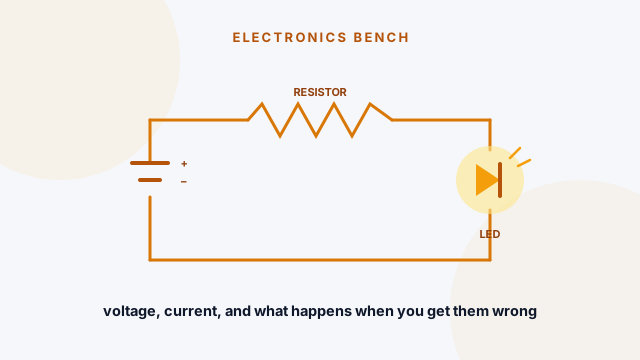
Before you build a circuit
The handful of ideas that make the Electronics bench lab make sense: what voltage, current and resistance actually are, why an LED needs a resistor, and how Ohm's law ties them together. Ten minutes.
12 blocks · by Froga
- 2

Before you build a CPU
The handful of ideas that make the Build a CPU lab make sense: what a truth table is, how counting works with nothing but on and off, and why adding two bits needs two digits. Ten minutes.
8 blocks · by Froga
- 3

How Operating Systems Decide What Runs Next
How a scheduler picks which process gets the CPU, and what goes wrong when it picks badly. For anyone curious what actually happens between pressing a key and seeing it appear on screen.
6 blocks · by Froga
- 4
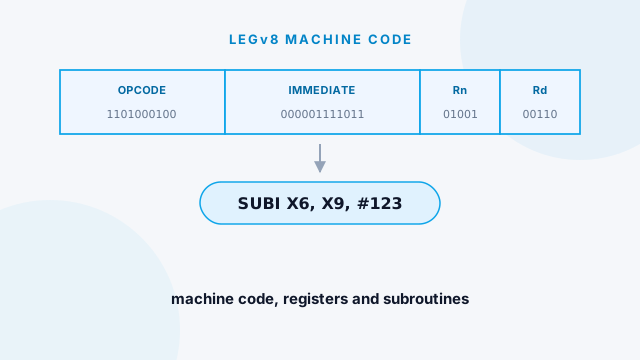
LEGv8: Machine Code, Registers & Subroutines
The machine code trips up more students than the assembly itself. Hex/binary conversion, MOVZ vs MOVK, immediate-value limits, and translating real bit patterns to assembly and back — practice built for 1DT301's labs and exam.
15 blocks · by turhan-ergene
- 5
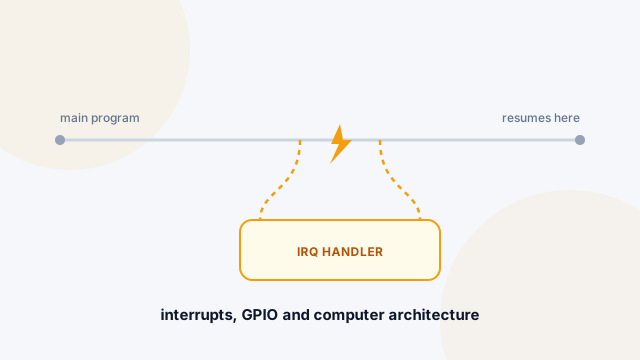
RPi Pico: Interrupts, GPIO & Computer Architecture
Polling vs interrupts, the IRQ vector, PC/LR/SP, and the buses that move data around a CPU — the theory half of 1DT301's Pico labs, the part that is easy to skip past while your LEDs are blinking.
12 blocks · by turhan-ergene
- 6

Before you write a program
The ideas the Program a siege lab assumes: what an instruction is, why input() never gives you a number, what a loop actually repeats, and the difference between printing an answer and returning one. Ten minutes.
9 blocks · by Froga
- 7

Big-O Notation: Measuring How Code Scales
Big-O notation is how programmers describe how an algorithm's speed changes as the amount of data grows. This room covers the common complexity classes and what they mean for real programs, for anyone just starting to learn algorithms.
6 blocks · by Froga
- 8

Hash Tables: Why Lookup Is (Usually) Instant
A tour of how hash tables give near-constant-time lookup, insertion and deletion, and the collisions and load factor that decide whether that promise holds. Written for anyone who has used a dictionary or map in code and wants to know what is happening underneath.
6 blocks · by Froga
- 9

Git Essentials: The Everyday Commands
The Git ideas the Git & GitHub lab leans on: the staging area, what a commit and a branch really are, merging, and the difference between undoing safely and rewriting history you already shared. About ten minutes.
11 blocks · by Froga