
Internet Security
This learning path covers how to protect computers, networks, data, and online communications from unauthorized access, attacks, and misuse.

- 1

Internet Security
A room to practise internet security concepts.
8 blocks · by Froga
- 2

Symmetric Encryption & Classical Ciphers
From Caesar's shift cipher to AES: what a cipher and a key actually are, why classical ciphers fall to frequency analysis, and why modern block ciphers replaced DES.
10 blocks · by Froga
- 3

Public Key Infrastructure (PKI)
Learn how trust is built on the internet. Explore how public–private key pairs, digital certificates, and Certificate Authorities work together to authenticate identities, secure communication, and prevent tampering.
8 blocks · by Froga
- 4

VPN Architecture & Protocols
Test your knowledge on how virtual private networks secure packet flow, contrast cryptographic handshakes across OpenVPN and WireGuard, handle NAT traversal, and mitigate routing leaks.
14 blocks · by Froga
- 5

Kerberos Authentication 1
A practical space for understanding how Kerberos verifies identities using tickets and time‑based security. Learn the core flow between clients, the KDC, and services, and build a solid grasp of how session keys and TGTs enable secure, efficient authentication in modern networks.
8 blocks · by Froga
- 6

Payment Security
How a card number is protected in storage, at the terminal, and at checkout -- PCI DSS, tokenization, EMV chips, and 3-D Secure, tied back to the encryption and certificates covered earlier in this path.
10 blocks · by Froga
- 7

Malware & Threat Landscape
The threats that work even when every cryptographic protocol is implemented correctly: malware types, social engineering, supply-chain attacks, and the defenses -- IDS/IPS, honeypots, backups -- built to catch each one.
10 blocks · by Froga
- 8

Asymmetric Encryption & Digital Signatures
Why public-key cryptography needs two keys, which one does what, and how running the pair backwards turns encryption into a signature.
8 blocks · by Froga
- 9

TLS: What Happens Before the Padlock
The handshake behind every HTTPS connection — what each side sends, how a shared key appears without ever crossing the wire, and what the padlock does and does not promise.
9 blocks · by Froga
- 10
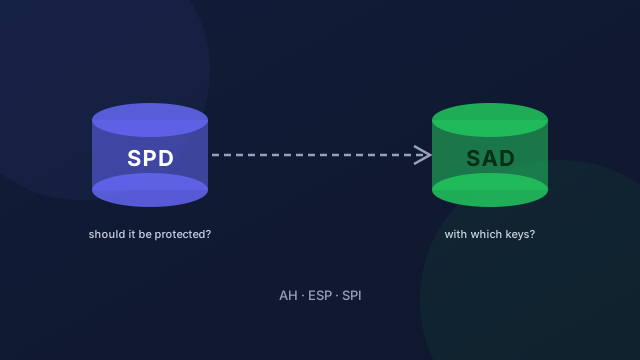
IPsec Internals: AH, ESP and the Two Databases
The machinery under an IPsec VPN — which of the two protocols encrypts and which only authenticates, what the SPI identifies, and the difference between the policy database that decides and the association database that holds the keys.
12 blocks · by Froga
- 11
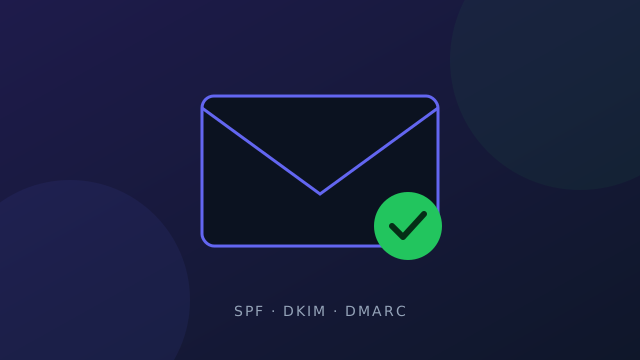
Email Security: SPF, DKIM and DMARC
Why a protocol with no authentication at all needed three bolted on afterwards — what each of the three actually checks, and which address a human reader is looking at.
7 blocks · by Froga
- 12
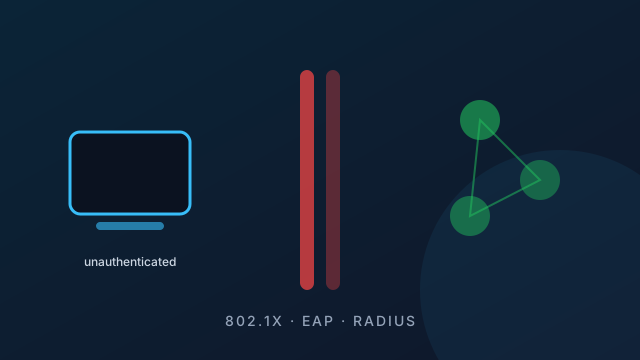
Network Access Control: 802.1X, EAP and RADIUS
Keeping unknown devices off the network before they reach it — the three parties in an 802.1X exchange, what the switch does and does not decide, and where EAP ends and RADIUS begins.
7 blocks · by Froga
- 13
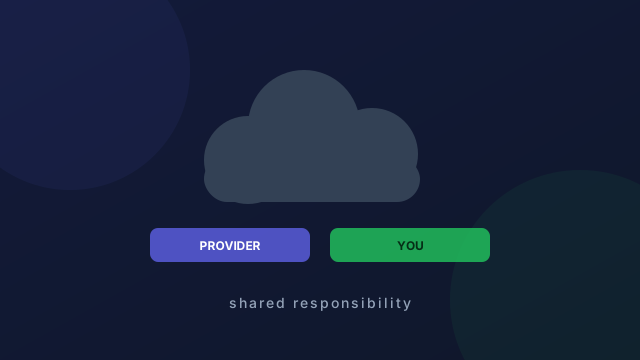
Cloud Security: Who Is Responsible for What
The shared responsibility model across IaaS, PaaS and SaaS — which layers move to the provider, which never do, and why most cloud incidents are configuration rather than compromise.
7 blocks · by Froga
- 14
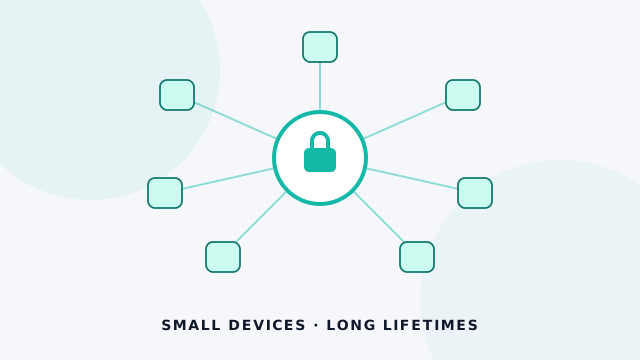
IoT Security: Small Devices, Long Lifetimes
Why security advice that works for servers fails on a sensor — constrained hardware, default credentials, devices that outlive their vendor, and why containment beats hardening.
7 blocks · by Froga