Official curated learning paths
The rooms that go with the maths labs, from arrows on a grid to how a language model picks its next word. Play a warm-up before its lab, and the rest alongside it.
The rooms that go with the computing labs, in the order the labs run: circuits, then logic gates and a CPU, then programs, then version control. Play a warm-up before its lab, and the rest alongside it.

What Words as arrows builds on: why a computer needs words as numbers, when two arrows point the same way, subtracting one arrow from another, and analogies in plain words. About ten minutes.

Modern web uygulamalarını tehdit eden gerçek açıklar. Her teknoloji kimliğini nasıl ele verir, açık tam olarak neyi mümkün kılar ve nasıl kapatılır. Express, Next.js, Django ve Apache. Küçük bayraklar saklı.

Web güvenliğine yeni başlayanlar için kısa bir sözlük: CVE ve CVSS nedir, istek–yanıt nasıl çalışır, RCE ile kimlik doğrulama/yetkilendirme ne demek, ve sırada hangi lab ve odalar var. Yaklaşık on dakika.

What Chance machines builds on: a chance worked out by counting, why all the chances add up to 100%, and when to multiply chances and when to add them. About ten minutes.

What Machine learning 2 builds on: the logic gates again, what makes a neuron fire, what a feature is, and why a perfect score on practice questions can mislead. About ten minutes.

The ideas the Web security 2 lab assumes: what a signed token is, how a database query is built from parts, why a server fetching a URL for you is different from you fetching it, and the theme under all of it — the server must not trust data just because it handled it. About ten minutes.

The ideas the Web security lab assumes: how a request and response work, what a URL’s parts are, what a cookie is, and the one that makes everything after it possible — the browser fills in the request, so the request is yours to change. About ten minutes.

What Machine learning 1 builds on: what a labelled example is, how a score decides spam or not, what "training" actually changes, and why you keep some examples back. About ten minutes.

The handful of ideas Linear algebra 2 builds on: multiplying matching parts, what a right angle means for two arrows, Pythagoras, and why "similar" can mean "pointing the same way". About ten minutes.

Starts from nothing: directions on a map, arrows you can add and stretch, and rules that move every point at once — which is all a matrix is. About ten minutes.


The ideas the Digital Forensics lab assumes: what a file signature is, what base64 does, how metadata hides in plain sight, and what a log line actually says. Ten minutes.

The maths behind the Crypto lab, without the heavy parts: bytes and hex, XOR, remainders, and why multiplying two primes is easy but splitting the answer is hard. Ten minutes.
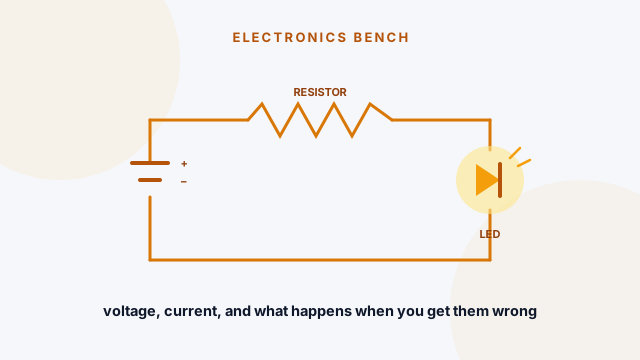
The handful of ideas that make the Electronics bench lab make sense: what voltage, current and resistance actually are, why an LED needs a resistor, and how Ohm's law ties them together. Ten minutes.

The ideas the Program a siege lab assumes: what an instruction is, why input() never gives you a number, what a loop actually repeats, and the difference between printing an answer and returning one. Ten minutes.

The handful of ideas that make the Build a CPU lab make sense: what a truth table is, how counting works with nothing but on and off, and why adding two bits needs two digits. Ten minutes.

The Git ideas the Git & GitHub lab leans on: the staging area, what a commit and a branch really are, merging, and the difference between undoing safely and rewriting history you already shared. About ten minutes.